Introduction
barranco is a useful Spanish noun that English-speaking learners often meet when reading about geography, travel, or nature. It describes a physical landform that can be dramatic and important for understanding landscape descriptions in Spanish-speaking countries. Knowing barranco helps learners identify features in maps, tourist guides, and stories, and it appears in everyday conversation when people talk about hikes, rivers, or coastal cliffs. This article explains the meaning, pronunciation, common uses, and examples so that learners can recognize and use barranco correctly in many contexts.
Meaning and Definition
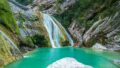
The basic meaning of barranco is a steep slope, ravine, or gully, usually formed by water erosion. It often refers to a deep, narrow valley with steep sides. In English you can translate barranco as ravine, gorge, or canyon depending on size and shape. The word emphasizes the steep, often rugged nature of the landform rather than a flat valley.
Nuance: barranco is commonly used for smaller or mid-sized features that are not as large as major canyons, but regional usage varies. In some areas, a coastal cliff carved by the sea might be called a barranco, while in others it refers strictly to river-carved gullies inland.
Etymology: barranco comes from Old Spanish and likely has roots in Iberian languages and Latin terms related to broken or rugged ground. The idea of a broken or uneven surface helps remember the meaning: think of land that has been cut or carved away.
Usage and Example Sentences
Spanish: El sendero baja por un barranco hasta el río.
English: The trail goes down through a ravine to the river.
Spanish: Hay flores silvestres creciendo en los bordes del barranco.
English: There are wildflowers growing on the edges of the ravine.
Spanish: Desde lo alto del barranco se ve el valle entero.
English: From the top of the gorge you can see the whole valley.
Spanish: Los niños observaron las aves que anidan en el barranco.
English: The children watched the birds that nest in the ravine.
Spanish: Después de la lluvia, el barranco estaba lleno de agua y piedras.
English: After the rain, the gully was full of water and stones.
Spanish: Construyeron un puente pequeño para cruzar el barranco.
English: They built a small bridge to cross the ravine.
Spanish: En la costa, el barranco forma acantilados impresionantes.
English: On the coast, the ravine forms impressive cliffs.
Spanish: El guía nos pidió no acercarnos al borde del barranco por seguridad.
English: The guide asked us not to get close to the edge of the ravine for safety.
Synonyms, Antonyms, and Word Usage Differences
Synonyms in Spanish for barranco include barranco mismo in many regions, and related words like garganta, cañón, and barranca. Each has a slightly different shade of meaning:
– garganta often suggests a narrow, deep passage like a throat; it can be used poetically for very narrow gorges.
– cañón usually refers to a large canyon, often deeper and wider, similar to the English canyon.
– barranca is another form used in some countries and is interchangeable with barranco in many places.
Antonyms would be words that describe flat or raised land: llanura (plain), meseta (plateau), or cima (summit). These represent landscapes that contrast with the steep, eroded nature of a barranco.
Choosing the correct word: Use barranco when you want to emphasize a steep, eroded slope or gully often formed by water. Use cañón when the feature is very large and dramatic, similar to famous canyons in English. Use garganta for very narrow, throat-like passages. Regional variation matters: in some Latin American countries barranca and barranco are the preferred terms for common gullies or ravines.
Pronunciation and Accent
Pronunciation guidance: barranco is pronounced [baˈraŋ.ko] in IPA for most varieties. Break it into syllables as ba-ran-co, with the stress on the second syllable: ran.
IPA: [baˈraŋ.ko]
Notes on sounds: The double r in Spanish generally indicates a trilled r sound, but in barranco the r appears as a single r after b, pronounced as a single flap [ɾ] in many accents. The n before c (which makes a k sound) often assimilates into a velar nasal [ŋ] in natural speech, so you may hear a sound like ba-RANG-ko. This is normal and acceptable.
Common mistakes: English speakers sometimes stress the first syllable (BA-ran-co) or try to pronounce the r as in English r. Practice placing the stress on ran and using the Spanish r sound (a tapped or slightly trilled r) to sound natural. Avoid pronouncing the c like an s in most Spanish-speaking countries—here c before o is a [k] sound.
Native Speaker Nuance and Usage Context
In everyday speech, native speakers use barranco in practical and descriptive ways. Hikers, farmers, and locals often refer to a nearby barranco when giving directions or describing natural hazards. For example, a farmer might warn about livestock falling into a barranco after heavy rains, or a tour guide might point out a barranco as a scenic viewpoint.
Formality: barranco is a neutral noun appropriate in both formal writing (geography reports, travel articles) and informal conversation. It does not carry slang or offensive meanings.
Figurative use: Sometimes speakers use geographical terms metaphorically. For instance, someone might speak of falling into a barranco figuratively to mean getting into a difficult situation or a sudden decline. This is less common than literal use but understandable in context.
Regional differences: In Spain and many Latin American countries, the preference for barranco, barranca, or cañón varies. In Mexico and parts of Central America, barranca or barranco are common. In coastal areas, the word can describe sea-formed cliffs as well as river valleys. When traveling, listen to locals to learn the preferred term for local landscapes.
Conclusion
Learning the word barranco gives you a clear way to describe steep, eroded landforms in Spanish. It is a common, neutral noun used in travel writing, conversation, and nature descriptions. Understanding its meaning, synonyms like cañón or barranca, and regional differences helps you choose the right word for each situation. Practice the pronunciation [baˈraŋ.ko] with stress on the second syllable and pay attention to the Spanish r sound. Use the example sentences from this article to recognize barranco in context and create your own sentences about hikes, coasts, and landscapes. Knowing barranco will make reading maps, listening to guides, and talking about nature in Spanish easier and more accurate.